filling planning question
Water Filler Valve Count and Output: How to Compare BPH
A rotary filler needs enough filling positions and enough time at each position to run the approved bottle. Compare valve count with carousel speed, available filling time and accepted output at the end of the water bottling line.
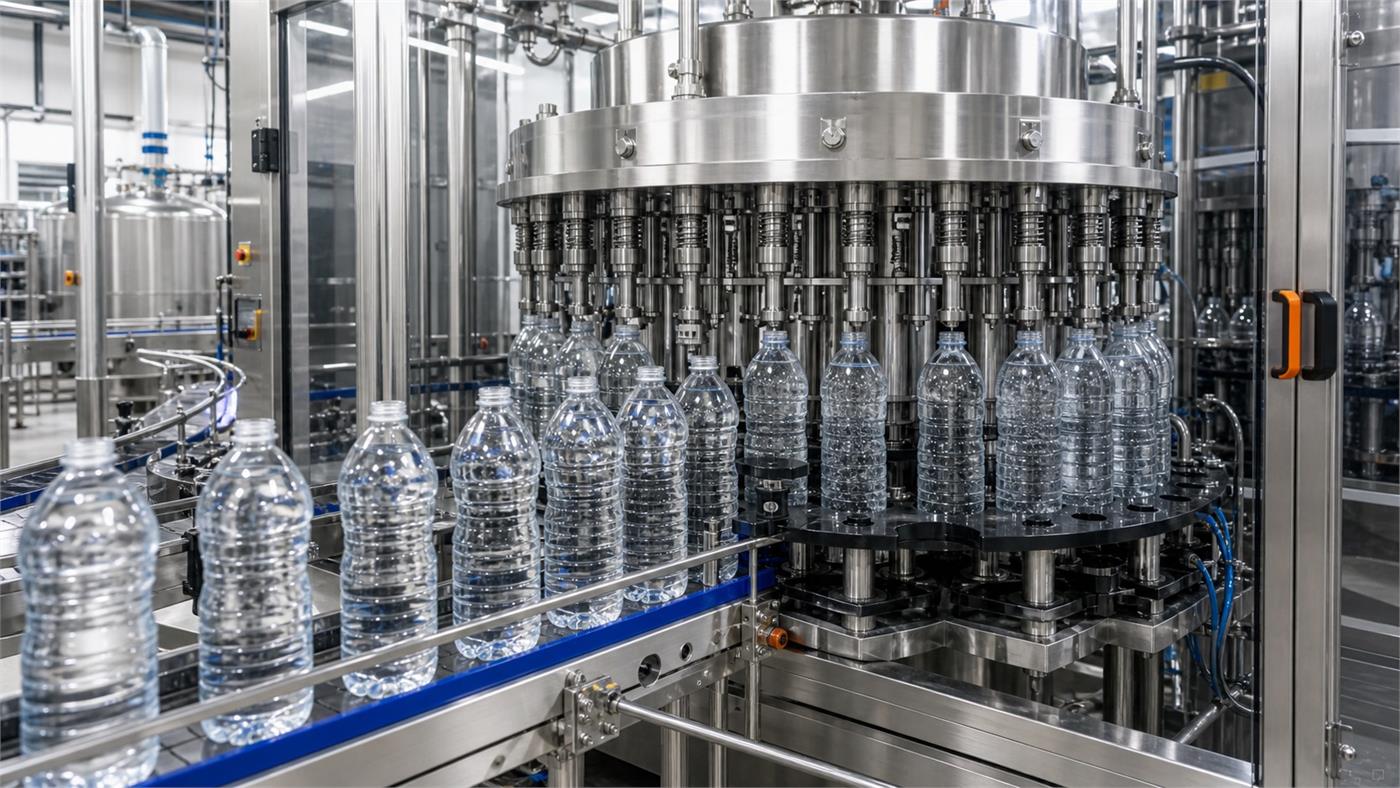
Start with the Bottle and the Output Boundary
Ask for separate figures for mechanical bottle positions, tested filler discharge and accepted finished packs. A valve count by itself does not establish any of these production commitments.
Calculate Mechanical Bottle Positions per Hour
For a single rotary carousel that handles one bottle at each filling position per revolution, theoretical positions per hour = filling positions × revolutions per minute × 60. This is a kinematic calculation before missing bottles, stops or rejected product. It does not apply unchanged to linear fillers or architectures with multiple bottle paths.
Illustrative arithmetic: 24 filling positions at 5 revolutions per minute give 24 × 5 × 60 = 7,200 positions per hour. This is not a quoted model, a recommended operating speed or evidence of 7,200 acceptable bottles. Every position must receive a bottle, complete the process and transfer it successfully for that theoretical count to become filled output.
For a rinsing-filling-capping monoblock, identify the rinsing positions, filling valves and capping heads separately. Suppliers can use different model-code conventions; request a labeled configuration drawing instead of assuming the numbers in a model name represent a guaranteed rate.
Check the Time Available for Filling
One revolution takes 60 ÷ rpm seconds. If the supplier defines an effective filling arc in degrees, the time within that arc is (filling arc ÷ 360) × (60 ÷ rpm). Ask whether the stated arc includes valve opening, flow reduction or other phases, or only liquid delivery.
Using hypothetical values of 5 rpm and a 180-degree effective filling arc gives 6 seconds. Increasing the same carousel to 6 rpm raises the theoretical count to 8,640 positions per hour but shortens that window to 5 seconds. These numbers illustrate the tradeoff only; the actual bottle, valve and process must support the required fill during the available interval.
A larger bottle may require a different flow profile or lower carousel speed. Neck opening, product conditions, metering method and bottle handling also matter. Request the supplier’s trial result for each launch format rather than scaling a small-bottle BPH figure by volume alone.
Separate Four Output Figures
Put the following records side by side. Keep units, counting location and elapsed-time boundary visible so a carousel calculation is not presented as packed production.
| Output figure | What is being counted | Evidence to request |
|---|---|---|
| Mechanical positions/hour | Available filling positions at the stated carousel rpm | Position count, machine architecture and speed basis |
| Filler discharge BPH | Bottles leaving the filler during a defined interval | Counting point, time boundary, empty-position and stop records |
| Accepted filled bottles/hour | Bottles passing the agreed fill and closure checks | Accepted count, rejected count and inspection criteria |
| Accepted packed output | Conforming finished packs, with bottles per pack identified | Packer-outfeed count, pack configuration and full-line test record |
Compare Two Filler Proposals on the Same Basis
For each approved bottle-and-cap combination, request the filling-position count, operating-speed range, product conditions, fill target and tolerance, and the proposed sustained output. Ask the supplier to identify which figure is calculated, tested or contractually committed.
Record the bottle and cap drawing revisions used in the trial, the start and finish times, acceptable bottles, rejected bottles and stop reasons. For a line trial, add the label and pack format and the final counting point. If the test removes a stopped interval, keep that result separate from output measured across the full elapsed window.
When the packer or cap supply cannot keep up, increasing filler rpm may add accumulation or stops without increasing saleable packs. Review the bottleneck and guaranteed-line-output pages before deciding that a higher valve count solves the production gap.
Technical References
Sidel describes a platform with different valve counts and bottle-size applications. Its model data is a manufacturer example; the worked calculations above are independent hypothetical examples. Sidel EvoFILL PET.
<p>Sources checked September 22, 2026. Manufacturer examples do not establish the configuration or performance of a quoted project.</p>
Buyer Questions
Does a filler with more valves always produce more bottles?
No. More positions can support a different speed or process-time balance, but the actual rate also depends on bottle handling, filling conditions, transfer, cap supply and downstream equipment. Compare the approved bottle-specific test basis.
Can BPH be calculated from valve count?
For a single rotary carousel processing one bottle per filling position per revolution, positions × rpm × 60 gives theoretical positions per hour. It does not include missing bottles, stops, rejects or limits elsewhere on the line.
Why can the same filler run fewer large bottles per hour?
A larger fill volume can require more liquid-delivery time or a changed flow profile, and the container may impose different handling conditions. The supplier should state and verify a rate for each approved format.
Which rate should appear in a complete-line commitment?
State the accepted output at an agreed counting point, for named bottles, caps, labels and packs, over a defined elapsed-time window with agreed quality and stop-accounting rules.
Request a Water Filler Valve Count and Output Scope Review
Share what you know now. The goal is to prepare a useful plant brief before a machine quotation is built.