format solution planning
1.5 Liter Water Bottling Line: Flow and Format Planning
A 1.5 liter bottle changes product-water demand, filled-container handling and the finished pack. Request an output rating for the actual 1.5L bottle and closure rather than carrying over a 500ml machine speed.
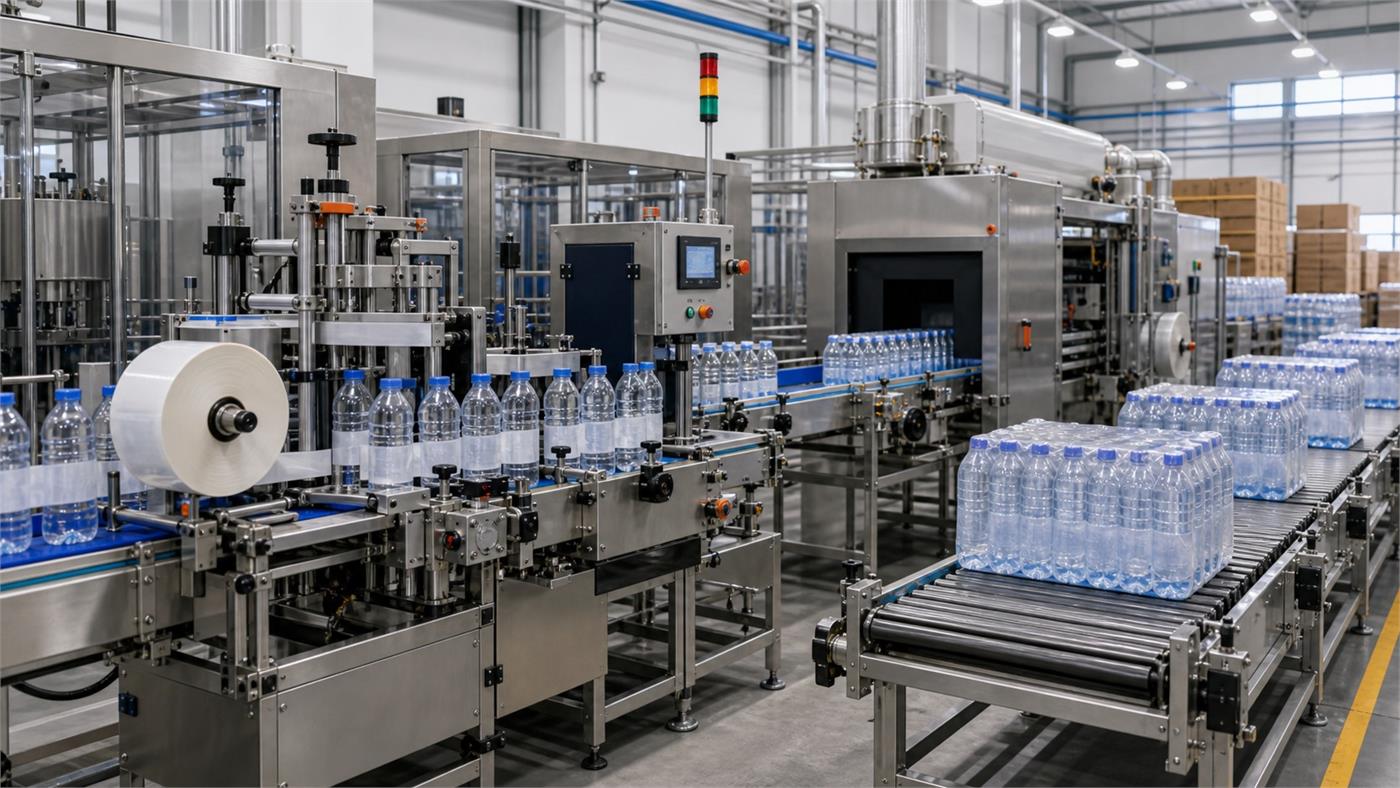
Bottles per Hour and Liters per Hour Tell Different Stories
At an illustrative 4,000 BPH, 1.5L bottles contain 6,000 L/hour of product water. The same 4,000 BPH in 500ml bottles contains 2,000 L/hour. This threefold product-volume difference does not imply a universal speed reduction; it shows why bottle-specific filling and supply data are necessary.
Check the Product-Water Supply at the Filling Point
Ask for the required conditions at the filler connection, the permitted variation and the intended filling process. Match these to treatment, storage and transfer design with the responsible suppliers.
Separate instantaneous filler demand from average daily water production. If treatment runs on a different schedule, the storage calculation needs inflow and outflow over time, not only one hourly number.
Include the rest of the water balance without assuming fixed losses or treatment recovery. The finished-product calculation is the starting quantity, not a complete treatment-system specification.
Follow the Filled Bottle Through the Dry End
Provide bottle height, base geometry, neck finish and the filled package mass for the actual design. Check guides, transfers, accumulation and infeed behavior using samples.
Specify the label position and panel, code location, pack count and material. A taller bottle can need different guide settings, sensor positions, handling parts or pack formation even when the closure family stays the same.
For a 6-bottle pack at 4,000 BPH, the running demand is 4,000 ÷ 6 ÷ 60 = 11.11 packs/minute. The liquid alone is 9 L per full pack; packing, pallet and handling decisions also need container and material mass and the agreed design limits.
Changing Between 500ml and 1.5L
List each change by machine: molds and blowing recipe if applicable, filler and transfer parts, conveyor guides, label recipe, code position and packer arrangement. Record which parts are shared and which need replacement.
Define changeover time from the last accepted old-format pack to the first accepted new-format pack, or another explicitly agreed boundary. Include adjustment, checks and first-off approval within the stated method.
Measure production time for each format at its own accepted good-output rate. Avoid calculating the mixed day by dividing total liters by a single bottle-speed rating.
What to Approve Before Ordering
Approve the launch bottle, cap, label and pack, the bottle-specific output basis and the whole-line change-parts list. Mark future formats as future until the supplier confirms compatibility and trial requirements.
Connect these approvals to the layout and utility schedules. A line that fits the floor can still lack the product supply or material handling needed for the larger bottle run.
Frequently Asked Questions
Will a 500ml line also fill 1.5L bottles?
It depends on the machine platform and approved package family. Ask for bottle-specific capacity, change parts, adjustment ranges, packer compatibility and a format trial.
How do I calculate 1.5L product flow?
Multiply the applicable bottle rate by 1.5 liters. At 4,000 BPH the filled product flow is 6,000 L/hour before separate process and treatment allowances.
Does the same neck finish eliminate changeover?
No. It may preserve some neck-handling interfaces, while bottle height, body geometry, labels, guides, sensors and packs can still require changes.
Discuss Your Water Bottling Line Requirements
Share what you know now. The goal is to prepare a useful plant brief before a machine quotation is built.