format solution planning
500ml Water Bottling Line: From PET Bottle to Retail Pack
A 500ml water bottling line must deliver a stable, correctly filled and closed bottle through labeling and packing. Specify the actual bottle and retail pack before selecting equipment; 500ml describes volume, not the neck, stiffness, shape or handling behavior.
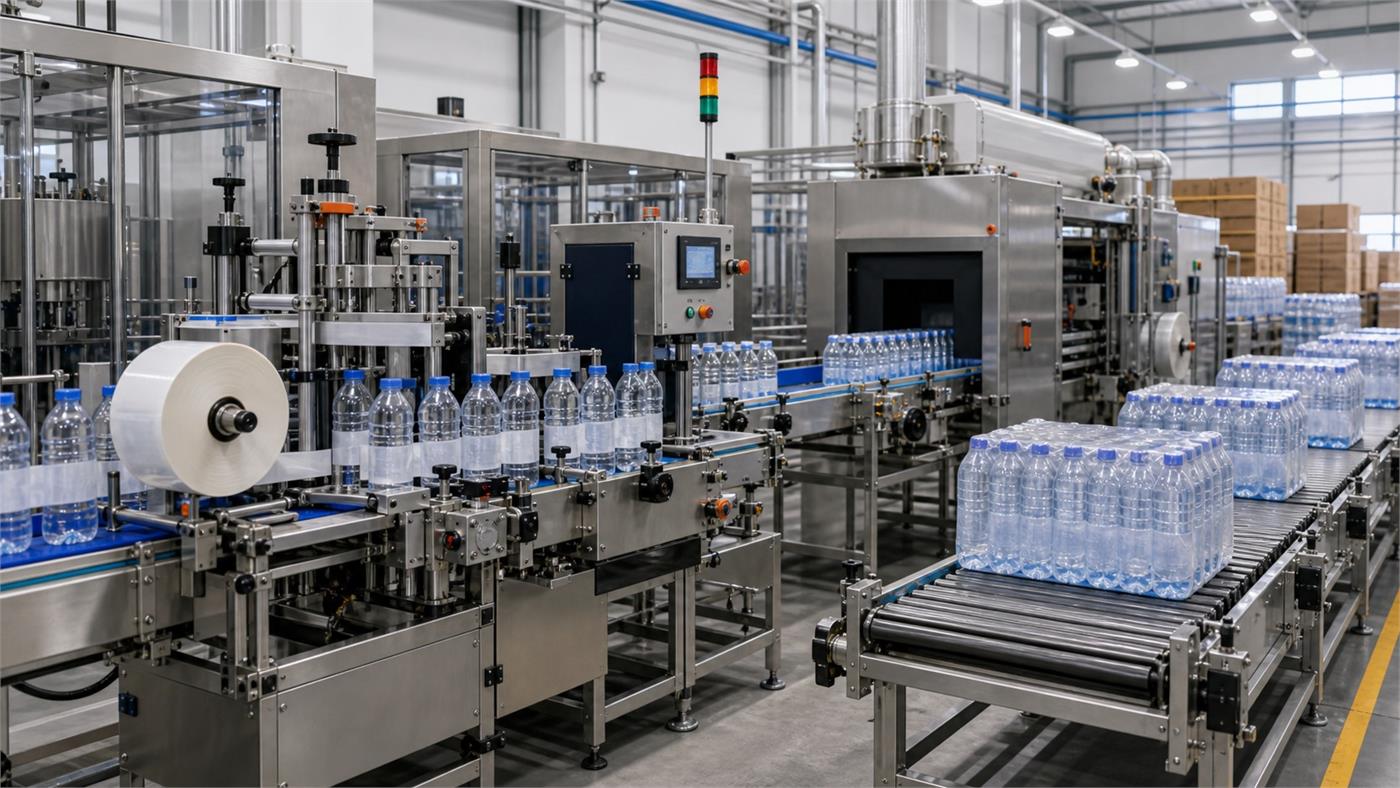
Approve the Package as One Set
Collect the bottle drawing, neck finish, closure specification, label artwork and pack arrangement in one controlled file. If bottles are blown in-house, add the preform and mold references. Use the same approved package across blower, filler, conveyor, labeler and packer trials.
Purchased Bottles or In-House Blowing?
With purchased bottles, plan receiving, protected storage, delivery frequency and feeding. Test how the chosen bottle enters the line and recovers after a short interruption. Include damaged-bottle separation in the receiving procedure.
With in-house blowing, confirm the bottle design against the selected preform, mold and blowing process. Include the required air, air treatment, cooling and transfer arrangement in the supplier boundary.
Compare the whole bottle-supply route. A lighter preform or a lower bottle purchase price may change handling behavior, losses and pack stability; any change needs a package and line trial rather than an assumed saving.
Translate Bottle Speed Into Retail Packs
Illustrative running case: 6,000 bottles/hour of 0.5 L equals 3,000 L/hour in filled product. It requires 500 complete 12-bottle packs/hour, or 8.33 packs/minute, when every bottle is accepted and supplied continuously.
Switching to 24-bottle packs halves the pack count to 250/hour, but does not prove the packer can handle the new arrangement. Pack dimensions, collation and the material process still need verification.
For daily planning, distinguish complete saleable packs from a partial remainder. For example, 32,000 bottles make 2,666 full 12-bottle packs with 8 bottles left over. A storage allowance may round handling positions upward; a sales total should not describe that remainder as another complete pack.
Trial the Transitions That Expose Instability
Observe the empty-bottle handoff, filler discharge, conveyor curves, accumulation and packer infeed. Record bottle tipping, scuffing, deformation and any manual intervention at the agreed operating conditions.
Check closure application and approved quality checks after normal restart and after the intended material change. Confirm that label and code quality remains acceptable under the actual bottle-surface conditions.
Run the real pack material through the approved process and check the finished pack after cooling or settling as applicable. Agree how rejected bottles and damaged packs are separated and counted.
Keep Future Formats Out of the 500ml Guarantee
List future 330ml, 600ml or larger bottles separately. Ask for the parts, recipes, output basis and test work required for each format. A shared neck finish can simplify some handling interfaces but does not establish compatibility across the complete line.
Use the verified 500ml route as the launch baseline, then make each additional format a controlled change to the package and production plan.
Frequently Asked Questions
How much product water is needed at 6000BPH for 500ml?
The filled product flow is 6,000 × 0.5 = 3,000 L/hour at continuous accepted output. Treatment and utility design also need the project water balance, losses and operating schedules.
Can a lightweight 500ml bottle run on any PET line?
No. Neck handling, sidewall stability, conveyor behavior, labeling and packing must be checked with the approved bottle at the intended operating conditions.
What should a 500ml acceptance run include?
Use the approved bottle, closure, label and pack material. Observe the complete route, record good packs, rejects and stops, and include the specified restart and replenishment cases.
Discuss Your Water Bottling Line Requirements
Share what you know now. The goal is to prepare a useful plant brief before a machine quotation is built.