integration planning
Bottle-to-Pack Water Bottling Line for Purchased PET Bottles
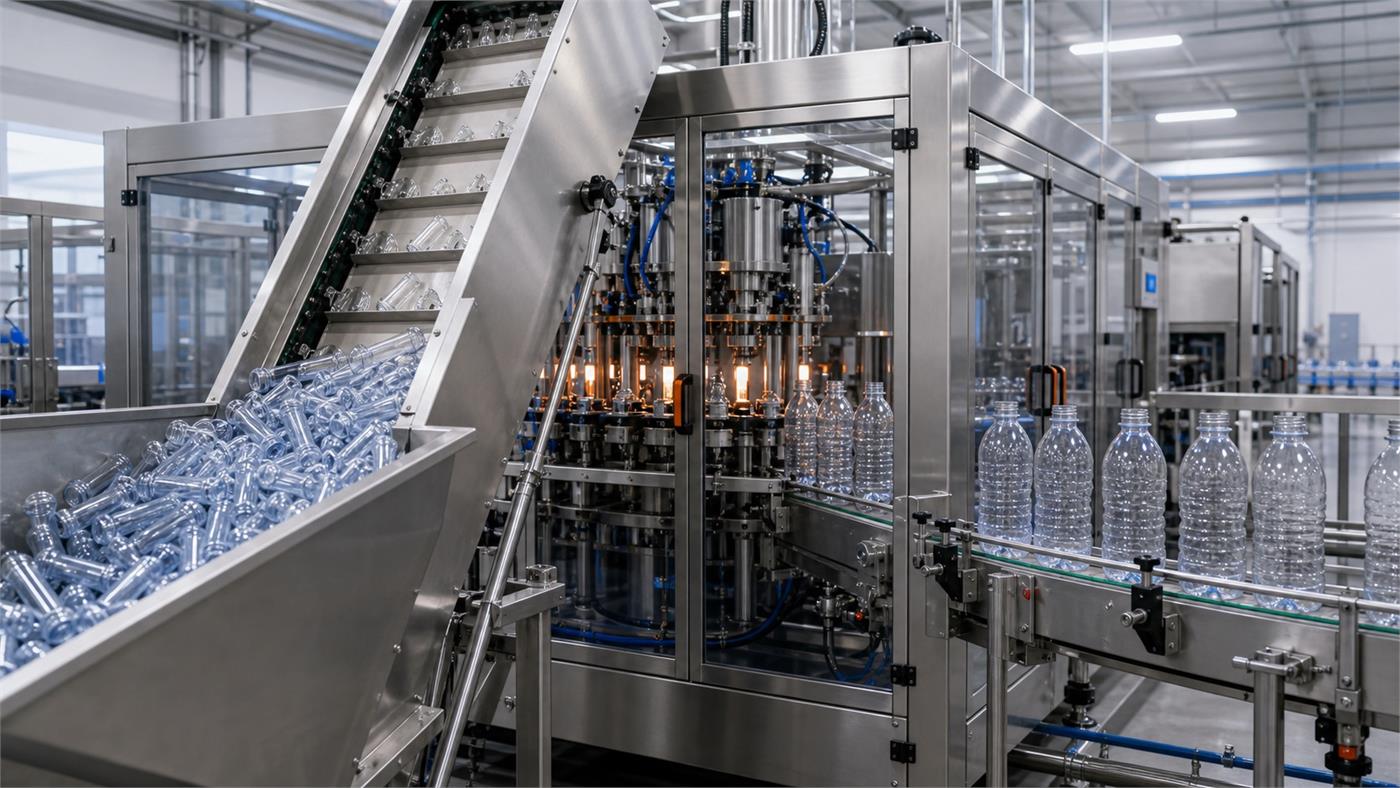
A bottle-to-pack water bottling line uses finished empty bottles supplied to the plant. The production scope starts at a defined bottle infeed and ends at an agreed retail pack. It can suit a launch stage where a dependable bottle supply is already available.
Define What Arrives at the Bottle Infeed
Specify whether bottles arrive loose, bagged, in trays or in another supply format. Agree the condition, inspection and handling steps between delivery and feeding. A filler-compatible bottle drawing does not by itself establish how the delivered bottles reach the machine.
Plan Receiving and Bottle Storage
Document supplier delivery quantity and frequency, protected storage, lot identification and the checks used for damaged or unsuitable containers. Separate the receipt of packaging materials from the exposed-product area.
Measure the storage demand using the actual packed delivery dimensions. Empty bottles can consume substantial handling space relative to their material mass, so a count of bottles is not a building-area estimate.
Plan the internal route and task ownership for replenishment. Verify that unloading or a stock movement does not interrupt clean bottle feeding or block access to the operating line.
Specify the Filling-to-Pack Route
Identify bottle feeding, the selected rinsing or preparation method, filling, capping and cap handling. Connect a suitable product-water supply using the conditions agreed with the filler supplier.
Define label and code requirements, inspection and rejection, accumulation and retail packing. Identify what remains manual, including material loading and movement of finished packs.
State the endpoint explicitly. A shrink-packed group of bottles at the packer discharge is different from an automatically palletized and secured load ready for dispatch.
Compare Purchased Bottles With Adding a Blower
Compare delivered bottle cost, storage, handling, supply reliability and documented losses against preform supply plus the full blowing route. The latter includes equipment, molds, auxiliaries, maintenance and operating skills.
Do not compare bottle purchase price with preform price alone. Use the same accepted bottle design, planning period and good-output requirement for both routes, with unpriced items left visible.
Keep the launch route practical. Adding blowing later should follow a measured supply or production need and a confirmed integration plan.
Reserve a Usable Future Interface
If future blowing is credible, show its proposed location, preform access, service space, utilities and the empty-bottle transfer connection on a separate expansion drawing.
Ask whether existing bottle feeding can remain as an approved alternative and how switching routes would work. Treat this as a specific control and transfer design, not an assumption that any future blower can be connected.
Test the launch route with the actual purchased bottles, including replenishment and ordinary restart. Accept the production boundary you are buying now before relying on a future option.
Frequently Asked Questions
Can I start a water line without a PET blower?
Yes, if suitable finished bottles are purchased and the receiving, protected storage and feeding route is defined. Treatment, filling, closing and the selected packing functions still need a complete scope.
What does bottle-to-pack exclude?
It does not automatically include bottle manufacture, water treatment, palletizing or warehouse handling. The quotation must state each boundary explicitly.
How should I prepare for a future blower?
Reserve the full operating and service space, auxiliaries and a designed bottle-transfer interface. Confirm compatible formats, controls and output before approving the expansion.
Discuss Your Water Bottling Line Requirements
Share what you know now. The goal is to prepare a useful plant brief before a machine quotation is built.